Trace Health: Researching GI diagnostic advocacy
Independent product research · Concept and research outputs
Stage: Independent product-strategy research conducted during graduate study. The work produced research and concept artifacts; it has not established clinical outcomes or patient/provider adoption.
The connection became clear when…
Watching someone you love struggle with serious digestive health issues changes your perspective on healthcare. When my girlfriend faced life-threatening GI complications, I saw firsthand how much coordination and layers of communication goes into obtaining a frightening diagnosis then have it turn into a path toward healing. But it was during my Hopkins graduate studies that the broader pattern became clear that younger patients with early-onset symptoms consistently faced systematic dismissal that led to dangerous diagnostic delays.
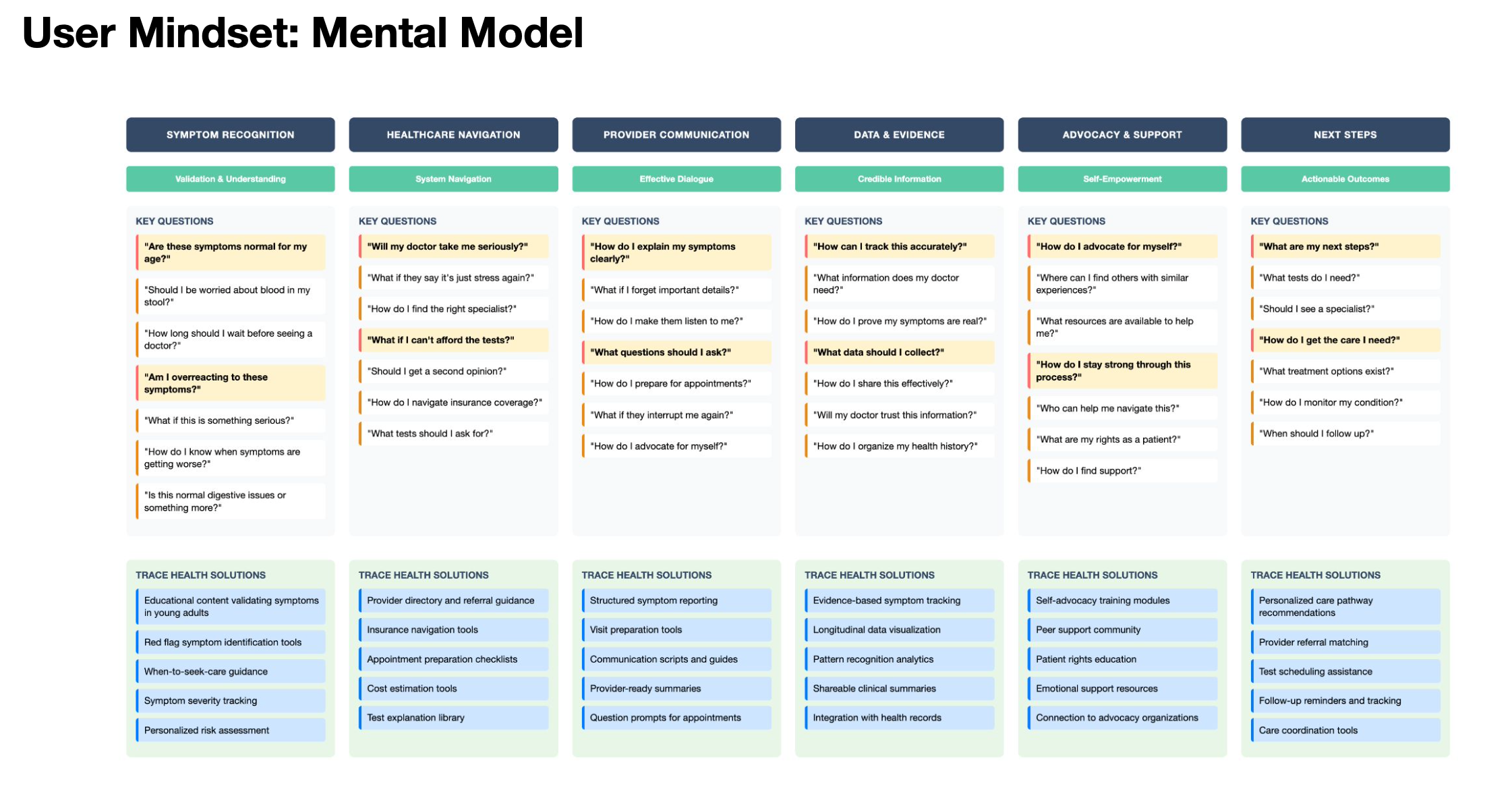
Through interviews with patients, providers, and researchers, I explored challenges on both sides: patients struggling to be taken seriously and providers facing constraints around screening protocols and compliance. The connection between individual experience and care-system barriers shaped a product hypothesis: structured symptom records and communication tools might help patients advocate for appropriate evaluation. The research used the “testimonial injustice” framework to examine those communication barriers.
My role
Conducted extensive independent research into 4-6 month diagnostic delay patterns affecting young adults with GI symptoms, using mixed-method approach including 14 patient interviews, 6 provider interviews, and systematic literature review of 45+ studies
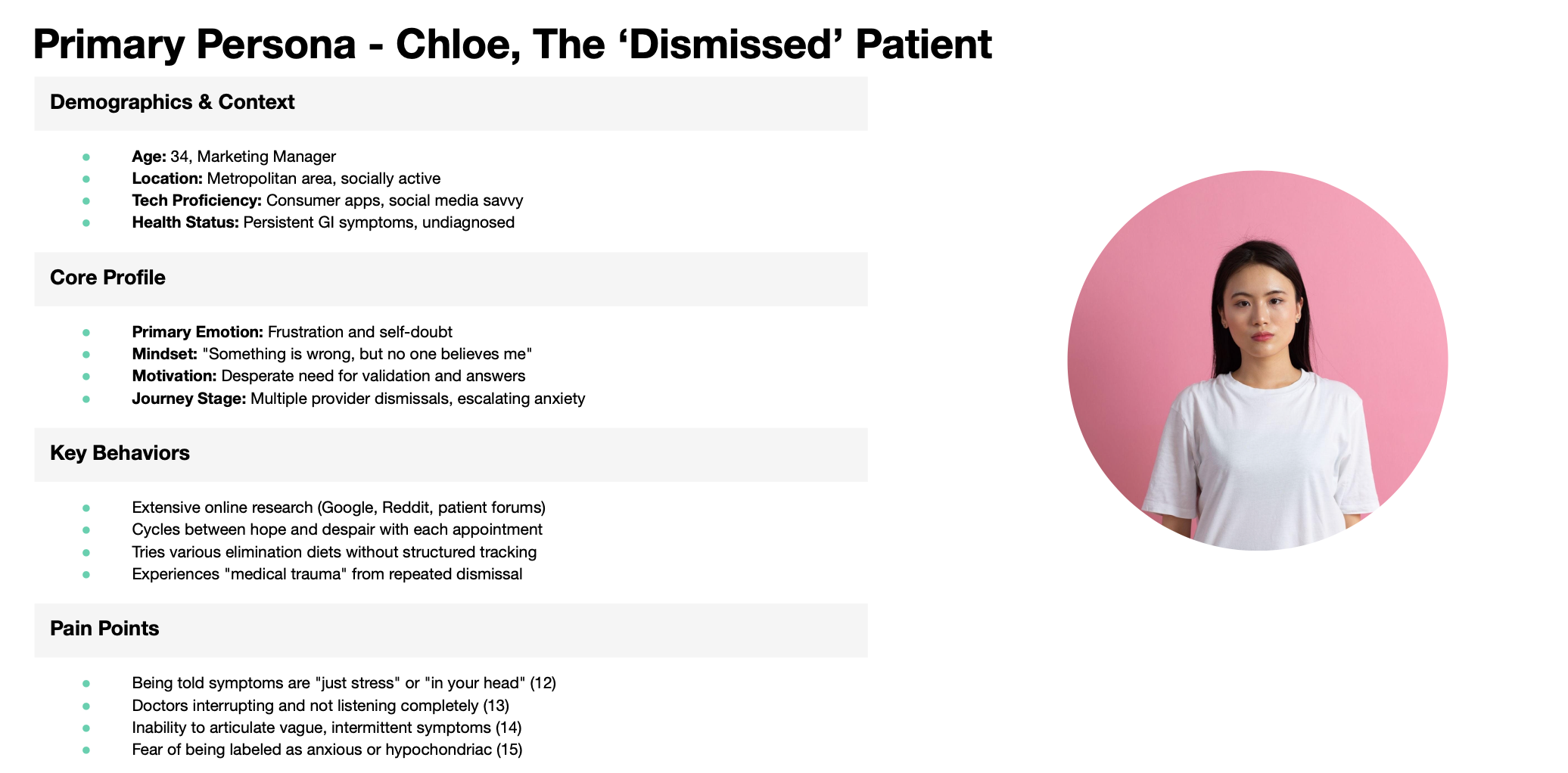
Applied design thinking methodology and thematic analysis to identify “testimonial injustice” as core user problem, performing competitive analysis across 8 digital health platforms to inform positioning strategy
Created a go-to-market strategy, personas, and journey maps; modeled a $59M total addressable market estimate for the proposed concept
Modeled potential savings of $270K per prevented late-stage diagnosis as a business-case estimate, not an observed benefit, and developed a roadmap from an initial MVP to potential expansion
Research outputs and limits
Developed a product strategy and market-opportunity hypothesis informed by interview and literature research
Created detailed user personas and journey maps based on clinical research and patient advocacy insights
Designed a proposed product roadmap with resource assumptions and development milestones
Built a business case estimating potential clinical and economic benefits under the research assumptions
These outputs support a product hypothesis. The market and savings figures are modeled estimates. The work has not shown that the proposed platform reduces diagnostic delays, improves clinical outcomes, or achieves those savings.
What I learned: This project taught me how to translate complex healthcare problems into structured product opportunities where the technology was new to me while maintaining deep empathy for patient experiences.
Discovery artifacts
Proposed experience
The concept prioritized four steps:
- Record symptoms and their context over time.
- Organize the patient’s history into a structured summary.
- Prepare questions and information for a provider conversation.
- Support continued tracking and care-navigation discussions.
This is a proposed experience, not a measured diagnostic pathway. No shortening of the diagnostic timeline has been established.